


Introduction: The Ad Ban Epidemic That’s Crushing Advertisers Right Now
Picture this: You spend three weeks testing creatives, fine-tuning your audience segments, and finally cracking a winning campaign. Your ROAS hits 4x. You’re ready to scale.
Then you wake up to an email that makes your stomach drop.
“Your ad account has been disabled for policy violations.”
No warning. No specific explanation. No appeal that actually works. Just a locked account, frozen budgets, and a business that just lost its primary revenue channel overnight.
If this sounds familiar, you’re far from alone. In 2026, Facebook and TikTok have tightened their advertising enforcement to an unprecedented level. Meta’s automated review systems flag and disable thousands of ad accounts every single day, many of them run by legitimate businesses that never intentionally violated a policy. TikTok’s enforcement has followed the same trajectory, with stricter content moderation and faster account-level penalties.
The reality is brutal: running paid ads on personal or self-managed ad accounts has become one of the riskiest things a digital advertiser can do. A single creative misinterpretation, a flagged landing page element, or even a sudden spike in spending can trigger automated enforcement that shuts everything down.
So, what separates advertisers who scale confidently from those who live in constant fear of the ban hammer?
The answer, for a rapidly growing number of serious advertisers, is an agency ad account.
An agency ad account is a pre-approved, platform-verified advertising account issued through a recognized marketing partner or agency. Unlike standard self-serve accounts that any individual can create, agency ad accounts carry a higher trust level with platforms like Meta and TikTok because they’re managed under established, compliant business entities with direct platform relationships.
In this guide, we’ll break down exactly how agency ad accounts work, and more importantly, the five specific ways they protect your campaigns from getting banned in 2026. Whether you’re running e-commerce, lead gen, app installs, or brand awareness campaigns, understanding this distinction could save your business.
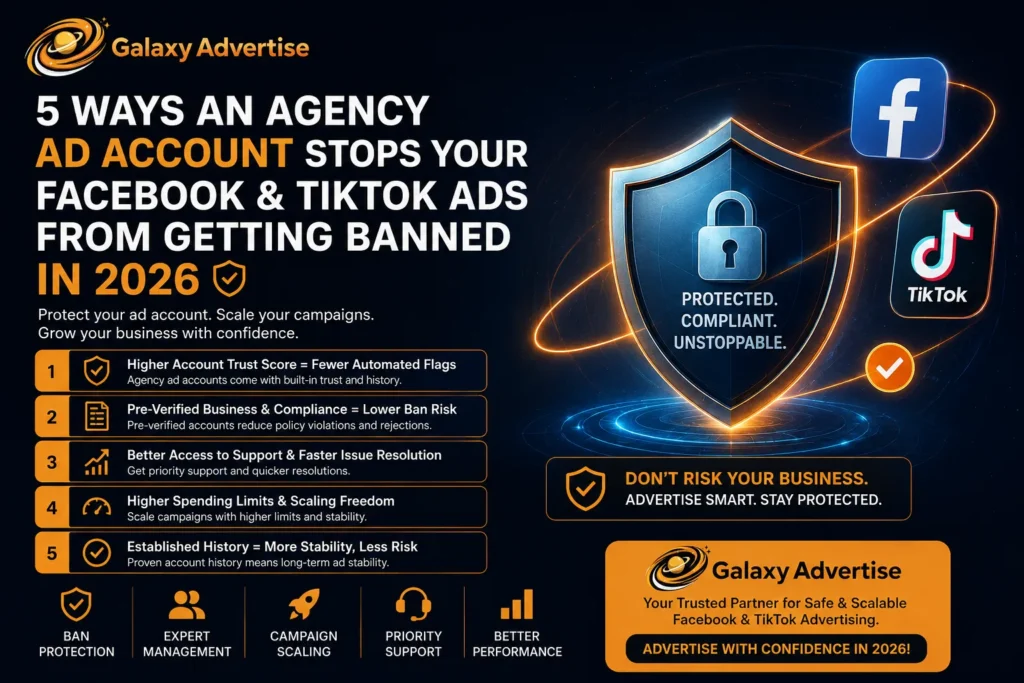
1. Higher Account Trust Score = Fewer Automated Flags
Every ad account on Meta and TikTok operates under what’s essentially an internal trust score. Platforms don’t publicly disclose the exact mechanics, but the evidence is clear: newer accounts, accounts with limited spending history, and accounts without established business verification are far more likely to get flagged by automated review systems.
Here’s where agency ad accounts fundamentally change the equation.
How Trust Scores Work Behind the Scenes
When you create a personal ad account or even set one up through a standard Meta Business Manager, you start at a baseline trust level. Every policy interaction, approved ads, rejected ads, landing page reviews, and user complaints feed into your account’s invisible trust metric. The problem? One rejected ad or a false-positive policy flag can cascade into account-level restrictions before you’ve built any positive history.
Agency ad accounts bypass this vulnerability. Because they’re issued under an agency’s established relationship with the platform, they inherit a higher baseline trust score from day one. The agency behind the account has already:
- Passed platform verification and compliance reviews
- Maintained a positive track record across thousands of campaigns
- Built direct relationships with platform support teams
The practical impact is massive. Advertisers using agency ad accounts report significantly fewer false-positive flags, faster ad approvals, and a dramatically reduced risk of account-level shutdowns compared to self-serve accounts.
Key Takeaway: An agency ad account doesn’t make you immune to policy enforcement, you still need compliant ads. But it gives you a compliance buffer that personal accounts simply don’t have.
2. Direct Access to Platform Support and Faster Dispute Resolution
Ask any advertiser who’s had their personal ad account disabled on Facebook or TikTok: what’s the most frustrating part?
It’s not the ban itself. It’s the silence afterward.
Standard advertisers who get flagged are stuck navigating automated appeal forms, chatbots that loop in circles, and support tickets that go unanswered for weeks. Many legitimate advertisers never recover their accounts at all, not because they violated policies, but because they simply couldn’t reach a human who could review their case.
Why Agency Accounts Get Priority Treatment
Agency ad accounts come with something that no amount of ad spend on a personal account can buy: escalation pathways to actual platform representatives.
Recognized agencies and their managed accounts have access to:
- Dedicated account managers or partner support channels at Meta and TikTok
- Priority review queues for flagged ads and account restrictions
- Direct communication lines for preemptive compliance checks before launching sensitive campaigns
This isn’t theoretical. It’s the difference between a 3-week appeal purgatory and a same-day resolution. When Galaxy Advertise manages an agency ad account for Facebook or TikTok, any account issues get escalated through established support relationships, not through a generic help center form.
Real-World Scenario
Consider an e-commerce brand running a flash sale campaign. The sudden spike in ad spend triggers an automated security flag. On a personal account, this typically results in an immediate account freeze with a 7-14 day (or longer) review process. On an agency ad account, the same flag gets intercepted, reviewed by a real person, and resolved, often within hours.
That’s not a marginal difference. For a business running time-sensitive campaigns, it’s the difference between a successful promotion and a complete loss.
3. Pre-Approved Compliance Frameworks and Policy Alignment
One of the biggest reasons ad accounts get banned isn’t that advertisers are intentionally breaking rules. It’s that platform advertising policies are dense, constantly updated, and interpreted inconsistently by automated review systems.
Meta’s advertising policies document alone spans dozens of categories. TikTok’s ad content guidelines add another layer of complexity, especially for industries like health, finance, supplements, and beauty, sectors where the line between “compliant” and “flagged” is razor thin.
How Agency Ad Accounts Stay Ahead of Policy Changes
Reputable agencies that issue ad accounts don’t just react to policy changes, they proactively adapt to them. Here’s how this works in practice:
| Feature | Personal/Self-Serve Account | Agency Ad Account |
| Policy awareness | Advertiser’s responsibility to monitor | Agency monitors and communicates changes |
| Creative pre-review | No pre-review available | Agency can pre-screen creatives for compliance |
| Industry restrictions | Same restrictions, higher flag risk | Agencies often have whitelisted access for regulated verticals |
| Landing page compliance | Self-managed, higher rejection risk | Agency guidance on compliant landing page structures |
| Account recovery | Automated appeals only | Escalated support with platform contacts |
Agencies like Galaxy Advertise maintain dedicated compliance teams that track policy updates across Meta, TikTok, Google, Snapchat, and other platforms in real time. When you’re running campaigns through an agency ad account, you benefit from this ongoing compliance infrastructure without having to build it yourself.
Industries That Benefit Most
Advertisers in the following verticals see the most dramatic ban-rate reduction when switching to agency ad accounts:
- E-commerce (especially dropshipping and direct-to-consumer brands)
- Health and wellness (supplements, skincare, fitness)
- Financial services (trading platforms, fintech, credit products)
- Real estate and lead generation
- Mobile apps and gaming
If you’re in one of these categories, your risk of account-level enforcement on a self-serve account is significantly higher, and an agency ad account is one of the most effective risk mitigation tools available.
4. Spending Stability and Gradual Scaling Without Red Flags
Here’s a pattern that catches more advertisers than any creative violation:
You’ve been spending $200/day. Your campaign is performing well, so you increase to $2,000/day. Within 48 hours, your account is restricted or disabled.
What happened? Nothing wrong with your ads. The platform’s security systems interpreted the sudden spending increase as potentially fraudulent or compromised account behavior. On personal and standard business accounts, this is one of the most common triggers for automated enforcement.
Why Agency Ad Accounts Handle Scaling Differently
Agency ad accounts are built for scale. Because they’re managed under agencies that routinely handle large advertising budgets across multiple clients, the platform’s systems are calibrated to expect, and accommodate, significant spending activity.
Here’s what this looks like in practice:
- Higher initial spending limits: Most agency ad accounts start with daily spend caps that would take a personal account months to reach.
- Faster limit increases: When you need to scale, limit increases are processed faster and with less scrutiny.
- Spending pattern recognition: Because the parent agency’s account has a history of diverse spending patterns, sudden increases on individual sub-accounts are less likely to trigger automated flags.
For advertisers who need to scale TikTok campaigns or ramp up Facebook spend for seasonal promotions, product launches, or aggressive growth phases, this stability is non-negotiable. It’s the operational foundation that lets you make strategic decisions based on performance data, not based on fear of triggering a platform algorithm.
5. Account Isolation: Your Campaigns Don’t Get Punished for Someone Else’s Mistakes
This is the protection most advertisers don’t think about until it’s too late.
On Meta’s platform, ad accounts within the same Business Manager can influence each other’s standing. If one ad account under your Business Manager gets flagged or banned, it can cascade and affect your other accounts, even if those accounts were perfectly compliant.
This is known as guilt by association, and it’s one of the most devastating enforcement patterns on both Facebook and TikTok. One bad actor (or even one honest mistake) on a shared Business Manager can take down an entire business’s advertising operation.
How Agency Ad Accounts Create a Firewall
When you operate through an agency ad account, your campaigns run under the agency’s infrastructure, isolated from any other advertisers’ compliance issues. This creates a critical protective layer:
- Your account is not linked to other unknown advertisers’ policy violations
- Business Manager contamination doesn’t affect your campaigns
- Individual account issues are contained and don’t spread across the agency’s portfolio, because agencies have systems to maintain portfolio-wide compliance
Think of it as renting a professionally managed apartment in a secure building versus sharing a house with strangers who might or might not follow the rules. Your lease, your reputation, and your security aren’t dependent on what happens in someone else’s unit.
For businesses that have experienced the devastating cascade of a Business Manager-level shutdown, where multiple ad accounts, pages, and assets get disabled simultaneously, this isolation model isn’t just convenient. It’s essential infrastructure for operational continuity.
Pro Tip: If you’ve previously had an ad account banned on Facebook or TikTok, starting fresh with an agency ad account through a provider like Galaxy Advertise gives you a clean slate without carrying over any negative account history.
Choosing the Right Agency Ad Account Provider in 2026
Not all agency ad accounts are created equal. The protection, support, and stability you get depends entirely on the agency behind the account. Here’s what to look for:
Platform partnerships: Does the agency have verified partner status with Meta, TikTok, Google, and other platforms? Direct partnerships mean stronger support access and higher account trust.
Compliance infrastructure: Does the agency actively monitor policy changes and provide creative guidance? A good provider doesn’t just hand you an account, they help you stay compliant.
Transparent pricing and terms: Avoid providers with hidden fees, vague terms, or no clear escalation process for account issues.
Proven track record: Look for agencies with documented experience managing large-scale campaigns across multiple verticals and platforms.
Multi-platform availability: Ideally, your agency should offer ad accounts across Facebook, TikTok, Google, Snapchat, and Taboola, so you can diversify your paid media without managing multiple provider relationships.
Galaxy Advertise checks every one of these boxes. With 5+ years of experience in social media advertising, verified platform partnerships, and dedicated compliance support, they’ve become one of the most trusted agency ad account providers for businesses that refuse to let platform enforcement derail their growth.
The Bottom Line: Agency Ad Accounts Are Infrastructure, Not a Luxury
If you’re spending real money on Facebook or TikTok advertising in 2026, running campaigns on a self-serve account is an unnecessary risk. The platforms have made their enforcement direction clear: stricter, faster, and more automated. Individual advertisers bear the brunt of this enforcement, while agencies with established compliance frameworks and platform relationships operate with significantly more stability.
An agency ad account won’t guarantee you’ll never face a policy review. It will ensure you have the trust history, support access, compliance infrastructure, spending stability, and account isolation to resolve issues quickl, so you don’t have to watch your revenue disappear behind an automated appeal form. Ready to protect your ad campaigns and scale with confidence? Get started with Galaxy Advertise and explore trusted agency ad accounts for Facebook, TikTok, Google, and more.
Frequently Asked Questions
1. What is an agency ad account?
An agency ad account is a platform-verified advertising account issued through a recognized marketing agency with direct partnerships with ad platforms like Meta (Facebook), TikTok, Google, and Snapchat. Unlike standard self-serve accounts, agency ad accounts carry higher trust scores, have access to priority support, and benefit from the agency’s established compliance track record.
2. How does an agency ad account prevent my Facebook ads from getting banned?
Agency ad accounts reduce ban risk through five key mechanisms: higher account trust scores that reduce automated false flags, direct access to platform support for faster issue resolution, proactive compliance frameworks that align your ads with current policies, spending stability that prevents scaling-related flags, and account isolation that protects you from other advertisers’ policy violations.
3. Can I use an agency ad account for TikTok advertising?
Yes. Agency ad accounts are available for TikTok through verified partners like Galaxy Advertise. TikTok agency ad accounts offer the same benefits as Meta agency accounts, higher trust, better support access, higher spending limits, and reduced ban risk, specifically optimized for TikTok’s advertising platform and content policies.
4. What’s the difference between an agency ad account and a regular Business Manager account?
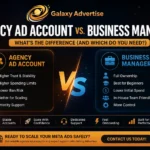
A regular Business Manager account is self-managed and starts with a baseline trust level that you build over time. An agency ad account is managed under an agency’s verified business entity, inheriting higher trust scores, priority support access, and compliance infrastructure from day one. Agency accounts also offer protection through account isolation, whereas Business Manager accounts can suffer from cross-contamination if any linked account gets flagged.
5. Is it legal to buy or rent an agency ad account?
Yes. Buying or renting an agency ad account from a verified provider is a legitimate business practice. Established agencies like Galaxy Advertise operate as official platform partners, and the accounts they issue are fully compliant with platform terms of service. The key is choosing a reputable provider with verified partnerships rather than unverified resellers.
6. How much does an agency ad account cost?
Pricing varies by platform, spending requirements, and the level of support included. Most reputable providers offer transparent pricing based on your monthly ad spend and the specific platform (Facebook, TikTok, Google, etc.). Galaxy Advertise offers affordable pricing tiers with dedicated support, making agency ad accounts accessible for businesses of all sizes.
7. Can an agency ad account help me recover from a previous ban?
While an agency ad account doesn’t reverse a previous ban on a personal account, it does give you a clean starting point. Because the agency ad account operates under the agency’s verified business entity, it is not connected to your previously flagged personal account or Business Manager. This allows you to resume advertising without carrying over negative account history.
8. Which industries benefit most from using an agency ad account?
Industries that face heightened ad policy scrutiny benefit the most, including e-commerce (especially dropshipping and DTC brands), health and wellness (supplements, skincare, fitness), financial services (fintech, trading, credit), real estate and lead generation, and mobile apps and gaming. These verticals see the highest rate of false-positive account flags on self-serve accounts.