


You’ve been running ads for a few months. Things are going well, conversions are climbing, your creative is dialed in, and you’re ready to pour fuel on the fire.
Then you hit a wall.
Your ad account gets flagged. Spend limits cap your budget at a frustrating ceiling. Support tickets disappear into a void. And suddenly, the difference between an agency ad account and a plain old Business Manager isn’t just a technicality, it’s the thing standing between you and revenue.
If you’ve ever asked yourself, “Do I need an agency ad account, or is my Business Manager enough?”, you’re not alone. It’s one of the most common questions advertisers face once they move past the beginner stage. And the answer matters more than most people realize.
Let’s break it down, clearly, honestly, and without the jargon soup.
What Is a Business Manager (and What Does It Actually Do)?
Meta Business Manager – now officially called Business Portfolio, is the organizational backbone of your advertising operation. Think of it as the filing cabinet that holds everything your business needs to run ads on Facebook, Instagram, and beyond.
Here’s what it manages:
- Facebook Pages and Instagram accounts
- Ad accounts (you can create multiple)
- Pixels, catalogs, and datasets
- Team member access and permissions
- Partner (agency) access controls
Business Manager is free. Every advertiser should have one. It separates your personal Facebook profile from your business assets, which is critical for security, team collaboration, and long-term stability.
But here’s the thing most people miss: Business Manager is not an ad account. It’s the container that holds your ad accounts. And the ad accounts you create inside it? They’re standard, self-serve accounts, which means they start with low trust, low spend limits, and zero priority in Meta’s review queue.
That distinction is everything when you’re trying to scale.
What Is an Agency Ad Account?
An agency ad account is a premium-tier advertising account created and managed by an official platform marketing partner, a verified agency that has a direct relationship with Meta, TikTok, Google, Snapchat, or other ad platforms.
Unlike the ad account you create yourself inside Business Manager, an agency ad account inherits the trust score, spending history, and platform relationship of the agency that provisions it.
What that means in practice:
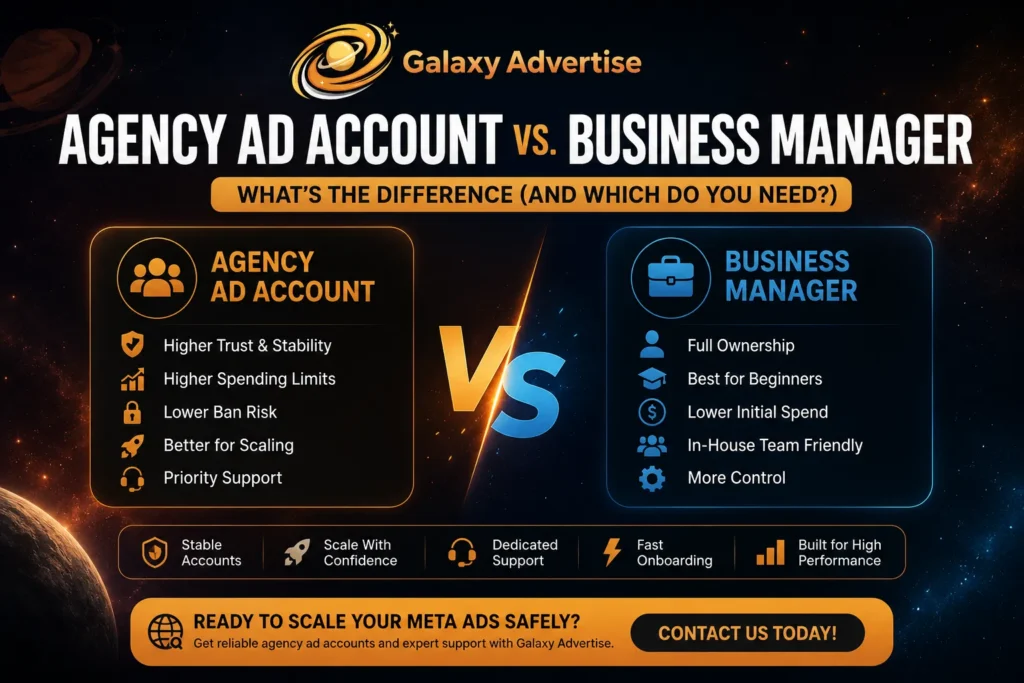
- Higher spend limits from day one. While a fresh self-serve account might cap you at $50–$250 per day, an agency account can unlock $10,000–$50,000+ daily budgets immediately.
- Reduced ban risk. Agency accounts carry established trust signals. They’re far less likely to get flagged by automated policy enforcement, a massive advantage for advertisers in competitive or sensitive verticals like e-commerce, finance, or health.
- Priority ad review. Your ads move through the approval queue faster, reducing downtime and keeping campaigns live.
- Dedicated support channels. Instead of generic chatbot responses, you get access to real platform representatives who can resolve issues quickly.
In short, if Business Manager is the filing cabinet, an agency ad account is the premium tool you put inside it, one that comes pre-loaded with credibility and operational advantages.
Agency Ad Account vs. Business Manager: Side-by-Side Comparison
| Feature | Business Manager (Self-Serve) | Agency Ad Account |
| What it is | Organizational tool / container | Premium ad account type |
| Who creates it | You (the advertiser) | An official platform partner agency |
| Cost | Free | Service fee (typically 4–10% of spend or monthly fee) |
| Ownership | You own it fully | Agency owns the account; you get managed access |
| Spend limits | Low starting caps; grows slowly over time | High or unlimited budgets from the start |
| Ban risk | Higher new accounts lack trust signals | Lower inherits agency’s trust score |
| Ad review speed | Standard queue | Priority review queue |
| Platform support | Automated / generic | Dedicated account representatives |
| Best for | Organizing assets, managing teams | Scaling ad spend, reducing account disruptions |
| Works on | Meta (Facebook/Instagram) | Meta, TikTok, Google, Snapchat, Taboola, and more |
Key takeaway: You don’t choose between these two. You need a Business Manager regardless. The real question is whether the ad accounts inside it should be standard self-serve accounts, or agency-grade accounts built for scale.
When a Business Manager Is Enough
Not every advertiser needs an agency ad account. If any of the following describe your situation, a standard Business Manager setup will serve you well:
- You’re spending under $3,000/month on ads
- You’re running campaigns on a single platform with a small team
- You haven’t experienced account restrictions or bans
- Your primary need is organizing assets and managing permissions
- You’re still in the testing phase of your ad strategy
Business Manager gives you everything you need to run professional campaigns at a modest scale. It’s the right starting point for most small businesses and solo marketers.
When You Need an Agency Ad Account
Here’s where things shift. An agency ad account becomes essential, not optional, when:
You’re Scaling Past $5K–$10K/Month in Ad Spend
Standard accounts hit artificial ceilings. You’ll submit a spending increase request, wait days for approval, and sometimes get denied with no explanation. Agency accounts eliminate that bottleneck entirely.
Your Accounts Keep Getting Banned or Restricted
If you’ve experienced the nightmare of a suspended ad account, especially one with active, profitable campaigns, you understand how devastating it is. Agency accounts, backed by verified partners, are significantly more resilient to automated flags and false positives.
You Operate in Sensitive or Competitive Niches
E-commerce brands scaling aggressively, finance and insurance advertisers, health and wellness companies, and dropshipping businesses all face higher scrutiny from ad platforms. Agency accounts provide a layer of protection that self-serve accounts simply don’t have.
You Need Speed and Reliability
When your business depends on continuous ad traffic, and every hour of downtime costs real money, the priority support and faster review times of an agency account aren’t luxuries. They’re business necessities.
You’re Running Multi-Platform Campaigns
If you’re advertising across Meta, TikTok, Google, and Snapchat simultaneously, managing agency accounts across platforms through a trusted partner streamlines everything, from billing to troubleshooting.
How Agency Ad Accounts Actually Work
Here’s the process, demystified:
- You partner with a verified agency – one that has a direct relationship with the ad platform (Meta Marketing Partner, TikTok Marketing Partner, Google Partner, etc.).
- The agency provisions an ad account under their business infrastructure, pre-loaded with higher trust and spend capacity.
- You receive advertiser-level access – you run your campaigns, control your creative, and manage your budgets. The agency handles backend infrastructure, billing, and platform liaison.
- Your existing Business Manager stays intact. The agency ad account is added alongside your current assets. You don’t lose your Pages, Pixels, or historical data.
One important nuance: with an agency ad account, the agency retains ownership of the account itself. You’re renting access to infrastructure that would take months (or years) to build on your own. That’s the trade-off- and for most serious advertisers, it’s a trade-off worth making.
What to Look for in an Agency Ad Account Provider
Not all providers are created equal. Here’s what separates a trustworthy partner from a risky one:
- Official platform verification. The agency should be a recognized Meta Marketing Partner, TikTok Marketing Partner, or Google Partner. Ask for proof.
- Transparent pricing. Reputable agencies charge a clear fee – usually a percentage of spend or a flat monthly rate. Avoid providers who are vague about costs.
- Dedicated support. You should have a direct point of contact – not just an email inbox.
- Multi-platform coverage. The best partners offer agency accounts across Meta, TikTok, Google, Snapchat, and native ad platforms like Taboola.
- Track record. Look for client reviews, case studies, and proof of long-term reliability.
At Galaxy Advertise, we’ve spent over five years building direct relationships with major ad platforms. Our clients get verified agency ad accounts across TikTok, Google, Facebook, Snapchat, and Taboola with dedicated support, transparent pricing, and the spend capacity serious advertisers need.
Common Mistakes to Avoid
Even experienced advertisers stumble here. Watch out for:
- Buying accounts from unverified sellers. This is the fastest path to a permanent platform ban. Always work through official partners.
- Confusing Business Manager with an ad account. They serve different purposes. Having a Business Manager doesn’t mean you have a high-trust ad account.
- Waiting too long to upgrade. Many advertisers only seek agency accounts after their self-serve account gets banned, by which point they’ve already lost momentum, data, and revenue.
- Ignoring multi-platform diversification. Relying on a single platform is risky. If your Meta account goes down, having a TikTok agency ad account or Google Ads agency account keeps your traffic flowing.
The Bottom Line
Business Manager is your foundation, the organizational tool every advertiser needs to manage assets, teams, and permissions securely.
An agency ad account is the performance upgrade, the high-trust, high-capacity ad account that lets you scale without the spend caps, ban anxiety, and support headaches that hold most advertisers back.
You don’t choose one or the other. You use both. The question is simply when you’re ready to make the upgrade.
If you’re already spending significantly on ads, hitting account restrictions, or planning to scale aggressively, the answer is probably now. Ready to scale your advertising with trusted agency ad accounts? Explore Galaxy Advertise’s solutions across Meta, TikTok, Google, Snapchat, and more, backed by 5+ years of platform partnerships and dedicated support.
Frequently Asked Questions (FAQs)
What is the difference between an agency ad account and Business Manager?
Business Manager (Meta Business Portfolio) is a free organizational tool that holds your Pages, Pixels, and ad accounts. An agency ad account is a premium ad account created by an official platform partner that comes with higher spend limits, lower ban risk, and priority support. Business Manager is the container; an agency ad account is the high-performance tool you put inside it.
Do I need a Business Manager to use an agency ad account?
Yes. An agency ad account is added to your existing Business Manager structure. You’ll still use Business Manager to organize your assets and manage permissions, the agency account simply replaces (or supplements) the standard self-serve ad account you’d normally use.
Can I keep my existing ad account if I get an agency ad account?
Absolutely. Getting an agency ad account doesn’t require you to delete or deactivate your current self-serve accounts. Most advertisers run both simultaneously, using the agency account for scaling and the self-serve account for lower-risk testing.
How much does an agency ad account cost?
Pricing varies by provider and platform. Most reputable agencies charge between 4% and 10% of your ad spend, or a flat monthly fee. At Galaxy Advertise, we offer transparent, competitive pricing across Meta, TikTok, Google, Snapchat, and Taboola.
Are agency ad accounts safe and legitimate?
Yes, when obtained through verified, official platform partners. Always confirm that your provider is a recognized Meta Marketing Partner, TikTok Marketing Partner, or Google Partner. Avoid buying accounts from unverified sellers on forums or social media, as this can lead to permanent bans.
Why do agency ad accounts have higher spend limits?
Agency ad accounts inherit the trust score and spending history of the partner agency. Since these agencies have established, verified relationships with ad platforms and manage large total ad budgets, their accounts are granted higher spending thresholds from day one.
Can agency ad accounts help prevent ad account bans?
They significantly reduce the risk. Because agency accounts carry established trust signals, they are far less likely to be flagged by automated policy enforcement systems. While no account is completely immune to policy violations, agency accounts provide a meaningful layer of protection, especially for advertisers in competitive or sensitive industries.
Which platforms offer agency ad accounts?
Agency ad accounts are available across all major advertising platforms, including Meta (Facebook and Instagram), TikTok, Google Ads, Snapchat, and native ad networks like Taboola. A trusted provider like Galaxy Advertise can set you up across multiple platforms simultaneously, so you’re never dependent on a single channel.